
Disclosure: This article contains affiliate links. If you book through them, we may earn a small commission at no extra cost to you.
- What is the Tateyama “Snow Corridor” (Yuki no Otani)?
- A Transit Lover’s Dream (or Endurance Test?): Navigating 6 Different Mountain Vehicles
- Firsthand Warning #1: Secure Your Advance “WEB Ticket” Reservation!
- Firsthand Warning #2: A Day Trip is Brutal—Expect Nearly 5 Hours One-Way!
- Firsthand Warning #3: Never Underestimate 2,450m Altitude—Dress Like You’re Going Skiing!
- Summary: A Once-in-a-Lifetime Silver World
- Frequently Asked Questions (FAQ)
What is the Tateyama “Snow Corridor” (Yuki no Otani)?
The Snow Corridor (Yuki no Otani / 雪の大谷)—often called the “Snow Wall”—is a colossal canyon of pure white snow located near Murodo Station at an altitude of 2,450 meters (8,038 feet) along the world-famous Tateyama Kurobe Alpine Route in Toyama Prefecture, one of the heaviest snowfall regions on Earth.
Every spring, specialized GPS-guided snowplows carve out the mountain road buried under months of winter blizzards, leaving sheer, towering walls of packed snow on both sides of the highway. Even if you have never been to Toyama, chances are you have seen photos of tour buses dwarfed by these dramatic white walls on posters or social media.
- Towering 12m–18m Snow Walls: Walk right beside sheer snow canyons equivalent to a 4-story building from mid-April through late June.
- 6 Different Alpine Vehicles: How to navigate the car-free route from Dentetsu-Toyama Station to Murodo and Kurobe Dam.
- Book Web Tickets Early (or Hunt Cancellations): Why slots sell out weeks ahead, how we snagged a cancellation 2 days before departure, and how same-day tickets work.
- Don’t Underestimate Travel Time & Altitude: Why Toyama to Kurobe Dam took us nearly 5 hours one-way, and why you need ski-resort winter gear for 0.5°C (33°F) weather even when Toyama City is 23°C!
Towering as High as a 4-Story Building!
“Seeing it in person, the sheer height blew us away!”
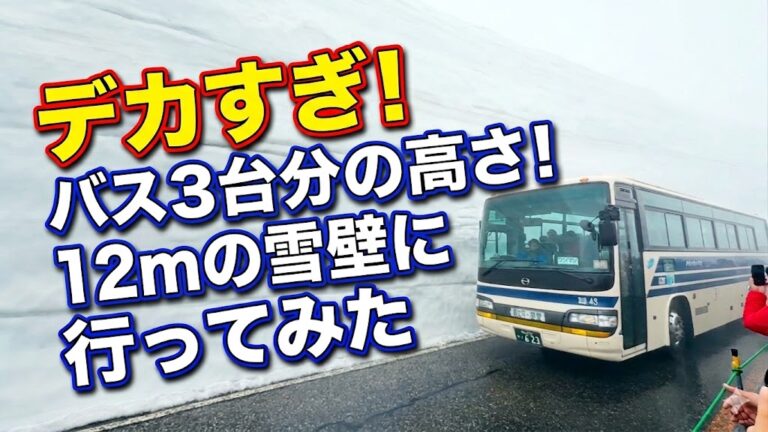
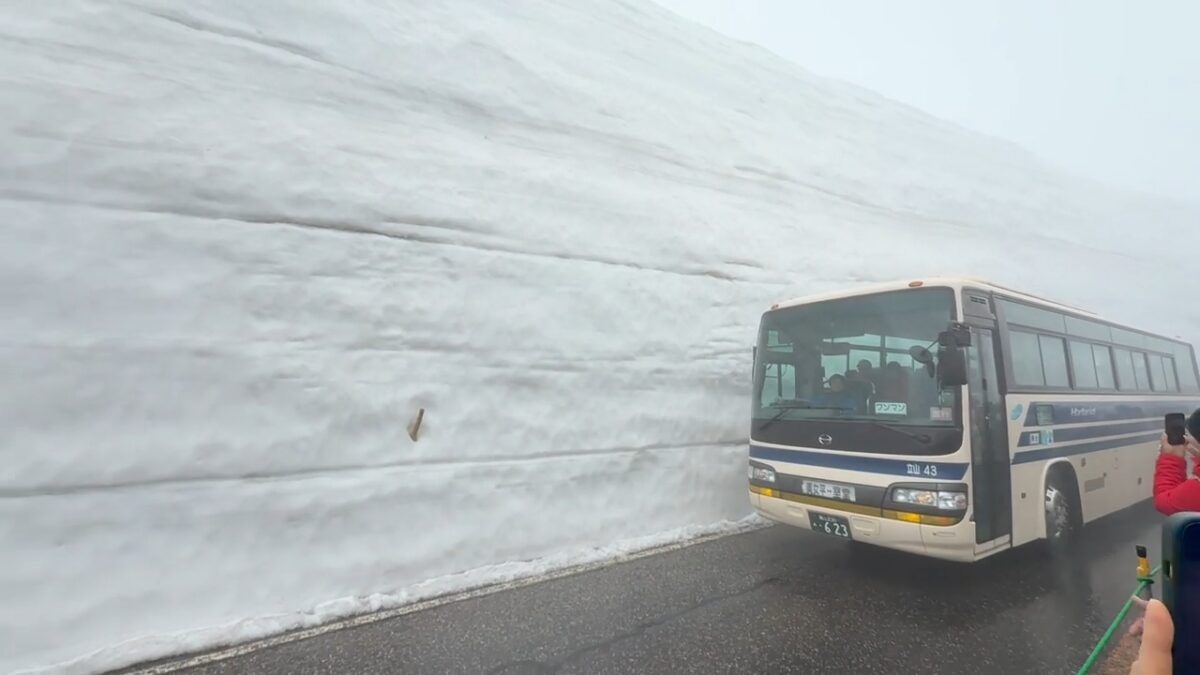
When we visited in spring 2026, the snow wall stood a staggering 12 meters (39 feet) high! (In heavy snow years like 2025, it can even reach 18 meters.)
Hearing “12 meters” might be hard to picture in the abstract, so here is how it compares to everyday landmarks: it is roughly equivalent to a 4-story apartment building, or three full-sized tour buses stacked on top of one another.
- Snow Wall Height (during our visit): 12 meters (approx. 39 ft)
- Average Building Floor Height: 3 to 4 meters
- Scale Comparison: 12m ≈ a 4-story building or 3 stacked highway buses
Because one lane of the road is cordoned off as a pedestrian walkway, you can walk right up next to the sheer ice-and-snow cliff. The overwhelming scale and vertical impact simply cannot be captured in photos or videos—it truly feels like a monument sculpted by nature.
Best Time to Visit: Mid-April Through Late June
The Tateyama Kurobe Alpine Route opens every year in mid-April. If you want to see the Snow Corridor at its tallest, brightest, and most pristine white, the prime window is right after opening, from mid-April through early May.
After May, the snow gradually melts down week by week, though the walls remain impressive and open for walking right up until late June.
If you are planning to go, make sure you read the practical warnings below first so you don’t get caught off guard by tickets, transit queues, or freezing mountain weather!
A Transit Lover’s Dream (or Endurance Test?): Navigating 6 Different Mountain Vehicles
The defining characteristic of the Tateyama Kurobe Alpine Route is its sheer number of vehicle transfers. Starting from the Toyama side (Dentetsu-Toyama Station), the journey up to Murodo and across to Kurobe Dam is like a department store of alpine transport. Rarely in life will you ride this many distinct forms of transport in a single day!
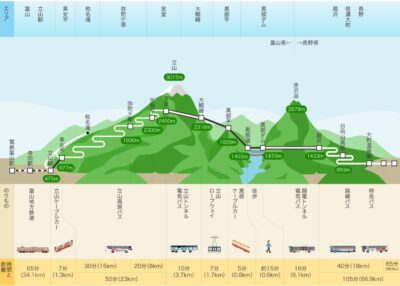
Source: Timetable & Route Map | Tateyama Kurobe Alpine Route Official Website
Private Cars Are Strictly Prohibited Beyond Tateyama Station
First, you take the Toyama Chiho Railway train from Dentetsu-Toyama Station to Tateyama Station (approx. 1 hour). While you can also drive a rental car up to Tateyama Station’s parking lot, beyond Tateyama Station, the entire Alpine Route is a strictly regulated car-free national park zone—private vehicles cannot enter. From here onward, everyone must travel via official alpine public transit, where advance online reservations are critical.
Step-by-Step: From Tateyama Station to Murodo (The Snow Corridor)
- Tateyama Cable Car (Funicular): Climbs a steep mountain slope from Tateyama Station up to Bijodaira in 7 minutes.
- Tateyama Highland Bus: Winds its way from Bijodaira up to the highest station on the route, Murodo (2,450m), in about 50 minutes.
- On Foot: Step out of Murodo Terminal and walk about 10 minutes to reach the towering 12-meter peak of the Snow Corridor!
Continuing to Kurobe Dam Requires Even More Transfers…
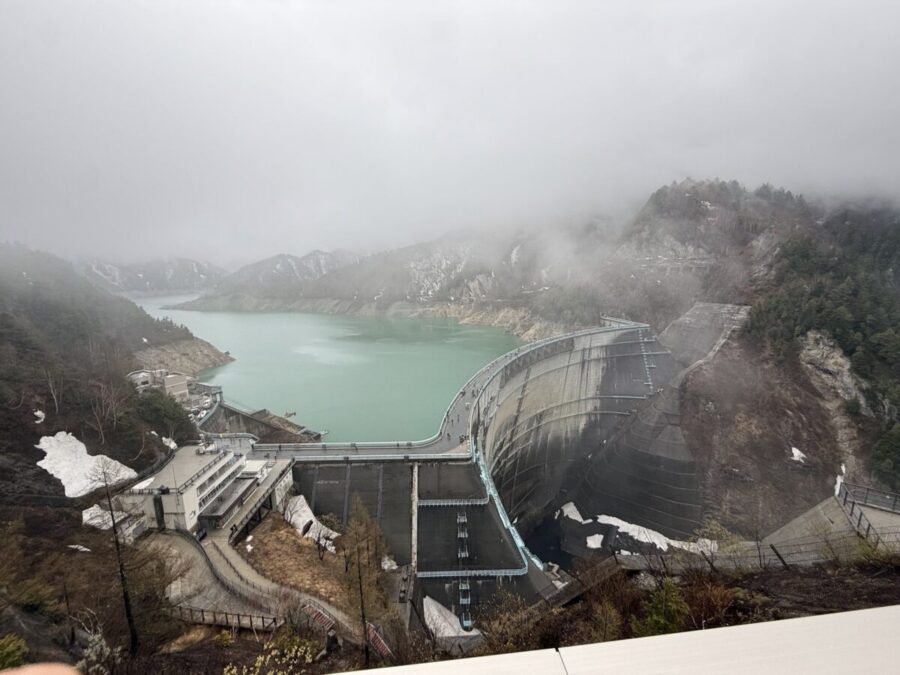
While some visitors turn back at Murodo after seeing the Snow Corridor, many push onward to the monumental Kurobe Dam. Be prepared: the chain of transfers from Murodo to Kurobe Dam is relentless!
- Tateyama Tunnel Electric Bus (formerly the Trolley Bus): Travels straight through the heart of Mt. Tateyama from Murodo to Daikanbo.
- Tateyama Ropeway: An aerial tramway without a single support tower in the middle, offering breathtaking panoramic views down to Kurobedaira.
- Kurobe Cable Car: An underground funicular descending from Kurobedaira to Kurobeko.
- On Foot: Walk through the tunnel out onto the crest of Kurobe Dam!
Train → Cable Car → Highland Bus → Tunnel Electric Bus → Ropeway → Underground Cable Car → Walk… Even typing out the sequence is dizzying! And if you are riding the Hokuriku Shinkansen home afterward, your total vehicle count climbs even higher. It is a full-day transit marathon, though riding all these engineering marvels is half the magic of the Alpine Route.
Firsthand Warning #1: Secure Your Advance “WEB Ticket” Reservation!
Looking back at our trip, the single biggest close call we had was booking our advance online tickets (WEB Kippu).
Because the Tateyama Cable Car has strictly limited passenger capacity per departure, the standard way to visit is by reserving a timed departure slot online via the official WEB Ticket (WEBきっぷ) portal.

Don’t Give Up Even If the Website Says “Sold Out”!
To be honest, we didn’t realize advance WEB Tickets existed until about two weeks before our trip. We immediately checked the official booking site, only to find that because it was peak spring season, every single time slot was completely “Sold Out.”
We nearly gave up hope, thinking our trip was ruined—but instead, we kept refreshing the official reservation calendar multiple times every single day. Miraculously, just 2 days before departure, a slot suddenly popped open! It was almost certainly a last-minute cancellation by another traveler, and we pounced on it immediately.
- Pro Tip: Even if your date shows “Full / Sold Out” right now, keep checking the official WEB Ticket calendar several times a day. Last-minute cancellations happen frequently in the final 2–3 days before departure!
Backup Option 1: Line Up Early for Same-Day Tickets
If you cannot snag an online reservation no matter how hard you try, you still have a backup option: limited Same-Day Tickets (当日券) are sold at the station windows every morning.
- Where to Buy: Sold at both Dentetsu-Toyama Station and Tateyama Station.
- Sales Start Time: Around 6:30 AM at Dentetsu-Toyama Station.
- Real-World Queue Conditions: Although notices at the station warned that people sometimes line up before 6:00 AM on peak holidays, when we walked through Dentetsu-Toyama Station around 7:00 AM, there was no crazy line left at the counter.
- Strategy: If you wake up early and line up before sales open at 6:30 AM, you have a strong chance of securing a same-day boarding slot.
Backup Option 2: Book an Organized Bus Tour
If online reservations are sold out and you don’t want to gamble on waking up at 5:30 AM for same-day tickets, check organized day tours or package tours (via platforms like Klook or major Japanese travel agencies).
- Why Tours Work: Tour operators hold pre-allocated group transport blocks on the Alpine Route, so they often have availability even when individual WEB Tickets are sold out.
- Cost Context: Even when traveling independently, a round-trip ticket from Dentetsu-Toyama Station to Kurobe Dam costs nearly ¥19,000 per adult (approx. ¥18,940) in transit fares alone. Keep that baseline fare in mind when comparing all-inclusive tour prices!
Why Traveling as an “Individual” Can Actually Be Faster on the Mountain
Once we arrived on the mountain, we noticed something fascinating: every transit boarding area separates queues into two lanes—“Group Tours (団体)” and “Individual Travelers (個人)”.
During our visit, the Group Tour lane had massive, winding lines, whereas the Individual Traveler lane was practically empty—it felt like having an express theme park FastPass! Because tour groups move in large blocks of 30–40 people, small groups of 1–2 individual travelers were frequently ushered onto the next vehicle smoothly with minimal wait times. If you value flexibility and shorter boarding lines, securing a WEB Ticket and going independently is unbeatable.
Firsthand Warning #2: A Day Trip is Brutal—Expect Nearly 5 Hours One-Way!
“It’s right next to Toyama City, so a day trip will be a breeze, right?” Think again! We departed Dentetsu-Toyama Station at 7:00 AM sharp, and by the time we made it back to our home in Tokyo that night, it was 9:00 PM—and that was with us rushing!
The Reality: It Took Nearly 5 Hours Just to Reach Kurobe Dam
When you look at the official timetable, the pure ride times make it look like you can get from Toyama to Kurobe Dam in 2.5 to 3 hours. Even factoring in transfers, we figured 4 hours would be plenty. Reality was much harsher:
- Our Actual Outbound Timeline:
- 07:00 AM: Depart Dentetsu-Toyama Station
- 12:00 PM (Noon): Arrive at Kurobe Dam (5 full hours one-way!)
- Why It Took So Long: Connection wait times at every single station. During peak Snow Corridor season, crowds are huge, and waiting 20–40 minutes between each of the 6 vehicles adds up rapidly. Even without taking a single detour on the way up, it took us five hours to reach the dam.
Our Return Trip Was Smooth, Leaving Almost Zero Time for the Snow Wall!
Thankfully, our timing on the return leg aligned perfectly, and we made it back down to Toyama Station with almost no connection waits:
- 5:30 PM: Return to Toyama Station
- 9:00 PM: Arrive back home in Tokyo via Hokuriku Shinkansen
While that return schedule looks smooth on paper, here is the catch: because the outbound climb to Kurobe Dam ate up 5 hours, we barely had any time left to enjoy the Snow Corridor at Murodo on the way back! With the afternoon closing deadline for the Snow Corridor walkway looming, we only had time to snap a few quick photos before hurrying to the bus terminal. If you want to savor both the Snow Corridor and Kurobe Dam without sprinting against the clock, stay overnight in Toyama City the night before (or on the mountain at Murodo) and board the very first morning departure.
Firsthand Warning #3: Never Underestimate 2,450m Altitude—Dress Like You’re Going Skiing!
If you think, “It’s late April or May, so spring clothes will be fine,” you will bitterly regret it on the mountain. Treat Toyama City at sea level and Murodo at 2,450 meters as two completely different countries and seasons.
A 20°C+ Temperature Drop: Practically Freezing at the Top
The day before our climb, downtown Toyama City hit a warm 23°C (73°F)—warm enough to break a sweat in a T-shirt. Even on the morning of our trip, Toyama City was a pleasant 15°C (59°F). Yet the moment we stepped off the bus at Murodo (2,450m), the thermometer read 0.5°C (33°F)!
- Toyama City (Sea Level): 15°C to 23°C (59°F–73°F)
- Murodo / Snow Corridor (2,450m): 0.5°C (33°F)
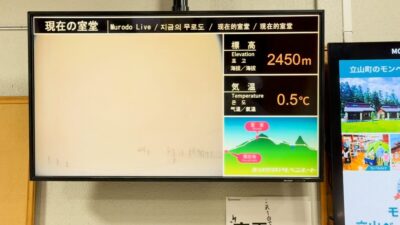
With wind chill blowing off massive walls of ice, 0.5°C feels bitterly cold. Even though I grew up in Hokkaido and pride myself on handling winter weather, I caught myself shivering and saying, “It is freezing up here!”
Must-Pack Gear We Learned the Hard Way
What suffered the most were my hands. Because I was holding a camera to film video for YouTube with bare hands, my fingers quickly went numb and stiff from the cold.
- Gloves & Scarf / Neck Warmer: Absolute lifesavers! Small accessories that you can easily slip on and off make regulating your body temperature effortless.
- Packable Down Jacket & Windproof Layers: A winter down jacket or windproof mountain parka is completely appropriate at Murodo. However, because you will feel hot again once you descend back to Toyama Station, dress in removable layers (heat-tech base layer + fleece + packable down + windbreaker).
- Sunglasses & Sunscreen: On clear days, the UV glare reflecting off the 360-degree snowfields is blinding.
Summary: A Once-in-a-Lifetime Silver World
The Snow Corridor on the Tateyama Kurobe Alpine Route is truly one of Japan’s most extraordinary natural wonders.
Being originally from Hokkaido, I thought I was completely used to heavy snow—yet standing at the base of those sheer 12-meter walls made me gasp out loud, “What on earth is this?!” It has a vertical scale and presence unlike anything even in Hokkaido.
Ever-Changing Scenery by Year and by Hour
While the corridor peaked at 12 meters in 2026, it reached 18 meters the previous year. Because you are dealing with raw alpine nature, the height and shape of the snow canyon change every single year. On the day we visited, thick mountain fog rolled in at times, turning visibility pure white—reminding us that clear blue skies at 2,450 meters are never guaranteed, which makes catching a clear view all the more rewarding.
Remember the three golden rules for a smooth trip:
- Lock in your advance WEB Ticket reservation (or check daily for cancellations)
- Allow plenty of buffer time (stay overnight near Toyama Station)
- Pack full winter layers, gloves, and sunglasses
Frequently Asked Questions (FAQ)
- QWhat clothes should I wear to the Tateyama Snow Corridor between April and June?
- A
At 2,450 meters elevation, Murodo stays near freezing (0°C to single digits Celsius) even in late spring. Pack a packable down jacket, a windproof outer shell, and warm gloves. Because UV reflection off the snow is intense, sunglasses and sunscreen are also essential, along with waterproof walking shoes or sneakers with good grip.
- QCan I buy Tateyama Kurobe Alpine Route tickets on the day of travel?
- A
While a limited number of same-day tickets go on sale at Dentetsu-Toyama Station (from around 6:30 AM) and Tateyama Station, peak Snow Corridor dates and weekends often sell out or require long waits. We strongly recommend reserving an advance timed-entry WEB Ticket online or booking a tour/pass package through Klook ahead of time.
- QWhere is the best place to stay when visiting the Tateyama Kurobe Alpine Route?
- A
If climbing from the Toyama side, staying at a hotel right beside JR Toyama Station / Dentetsu-Toyama Station the night before is by far the most convenient choice. It lets you board an early-morning train to Tateyama Station without stress and enjoy Toyama Bay’s famous fresh sushi, white shrimp (shiro-ebi), and Toyama Black Ramen in the evening.

コメント