
Disclosure: This article contains affiliate links. If you book through them, we may earn a small commission at no extra cost to you.
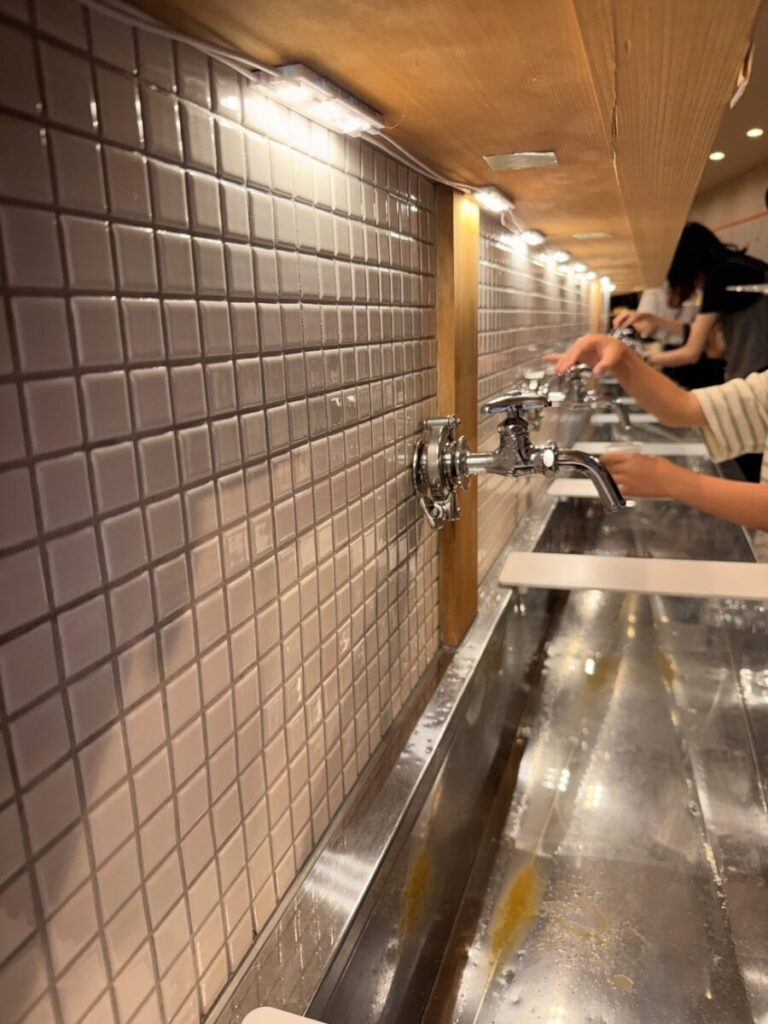
If there is one playful culinary experience you simply cannot miss while exploring Dogo Onsen and Matsuyama in Ehime Prefecture, it is pouring fresh local mikan (mandarin orange) juice straight from a household water faucet!
During our visit to the Dogo Onsen shopping arcade, we stopped by the spot drawing the longest, most excited line on the street: “Ehime no Shokutaku 1970” (愛媛の食卓1970 — literally “Ehime’s Dining Table 1970”).
Standing in front of a wall lined with 20 gleaming faucets and turning the tap to fill your cup with 100% pure, single-origin Japanese citrus juice is guaranteed to make both adults and kids grin from ear to ear.
Even better, this shop is operated by the same renowned local group behind 10 FACTORY (Ehime’s premier artisanal citrus brand, which also has a boutique in Tokyo’s GINZA SIX), meaning the quality of the juice is top-tier. In this review, we share the story behind the shop, how the self-serve tap system works, and our honest tasting notes after comparing 10 different Ehime citrus varieties side by side!
- Prime Location in Dogo Onsen: Just a 1-minute walk from Dogo Onsen Station inside the covered Dogo Haikara Dori shopping arcade.
- The 1970s Urban Legend Come True: Why people in Japan joke that “orange juice comes out of the tap in Ehime.”
- 10-Variety Tasting Review: Honest flavor breakdown from refreshing Haruka and Kawachi Bankan to ultra-luxury Beni Madonna and Beni Princess.
- Practical Visitor Tips: Opening hours, pricing system, and how to pick your favorite sweet vs. tangy taps.
- Location & Store Information: “Ehime no Shokutaku 1970”
- Born from an Urban Legend: Why Is It Called “1970”?
- Operated by the Makers of “10 FACTORY”: Serious Citrus Quality
- Tasting Review: Comparing 10 Rare Ehime Citrus Varieties Side by Side!
- Frequently Asked Questions (FAQ)
- Summary: Don’t Leave Dogo Onsen Without Turning the Mikan Tap!
- More Ehime, Dogo Onsen & Shimanami Kaido Guides
Location & Store Information: “Ehime no Shokutaku 1970”
Ehime no Shokutaku 1970 is located right in the heart of Dogo Haikara Dori (the Dogo Onsen Shopping Arcade), connecting Dogo Onsen Station to the historic Dogo Onsen Honkan bathhouse.
Because the entire street is a covered pedestrian arcade just a 1-minute walk from the tram station, it is an easy, weather-proof stop whether you are strolling in a cotton yukata robe after a hot spring bath or visiting on a rainy afternoon.
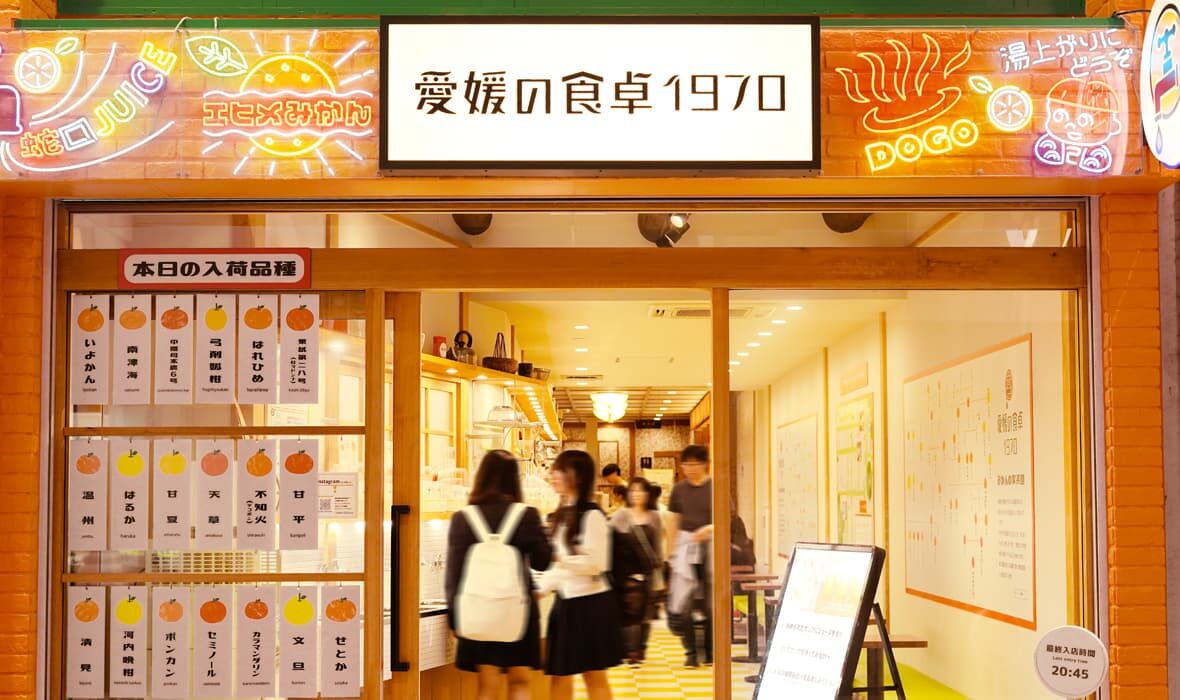
Ehime no Shokutaku 1970 – Quick Facts
- Name: Ehime no Shokutaku 1970 (愛媛の食卓1970)
- Address: 12-30 Dogo Yunomachi, Matsuyama, Ehime 790-0842 (Google Maps)
- Access: Approx. 1-minute walk from Iyotetsu “Dogo Onsen Station” (Inside Dogo Haikara Dori Shopping Arcade)
- Opening Hours: 9:00 AM – 9:00 PM (Last Order 8:45 PM)
- Closed: Open year-round (irregular maintenance closures)
Bonus Tip: Sister Store “Ehime no Gakko 1970” on Ropeway Street
Near the Matsuyama Castle Ropeway street in central Matsuyama, you can also visit their sister shop, “Ehime no Gakko 1970” (Ehime’s School 1970). Styled after a nostalgic 1970s Japanese elementary school classroom, it offers another fun retro backdrop when sightseeing around Matsuyama Castle!
Born from an Urban Legend: Why Is It Called “1970”?
Across Japan, there is a famous tongue-in-cheek urban legend about Ehime Prefecture: “In Ehime, when you turn on the kitchen faucet, mandarin orange juice comes out instead of water!”
According to the official history shared by operator W-HARMONY Co., Ltd., this joke originated in the 1970s (late Showa era). When university students from all over Japan gathered in Tokyo or Osaka and bragged about their hometowns, students from citrus-rich Ehime would jokingly tell their classmates, “Back home in Ehime, mikan juice flows right out of our household taps!”
The number “1970” in the store’s name pays homage to the decade this beloved urban legend was born, and the interior recreates a warm, retro 1970s Japanese family dining room—complete with vintage televisions, retro refrigerators, and patterned tableware.
What began as a joke was actually brought to life in 2007 by Ehime Beverage Co. (makers of Japan’s famous POM Juice) and debuted at Matsuyama Airport in 2008, quickly becoming Ehime’s most iconic tourism symbol.
Operated by the Makers of “10 FACTORY”: Serious Citrus Quality
Ehime no Shokutaku 1970 is run by Matsuyama-based W-HARMONY Co., Ltd.—the same culinary group behind 10 FACTORY (the celebrated specialty citrus brand with locations in Dogo and Tokyo’s GINZA SIX) as well as famous local sea bream rice (taimeshi) restaurants Akiyoshi and Gansui.
Because of this pedigree, the shop is far more than a novelty photo spot. Every faucet dispenses 100% straight, single-cultivar Ehime citrus juice with no added sugar or artificial flavoring, allowing you to taste the genuine agricultural terroir of Japan’s citrus capital.
Tasting Review: Comparing 10 Rare Ehime Citrus Varieties Side by Side!
During our visit, we decided to go all-in and try a 10-variety mikan juice tasting flight!
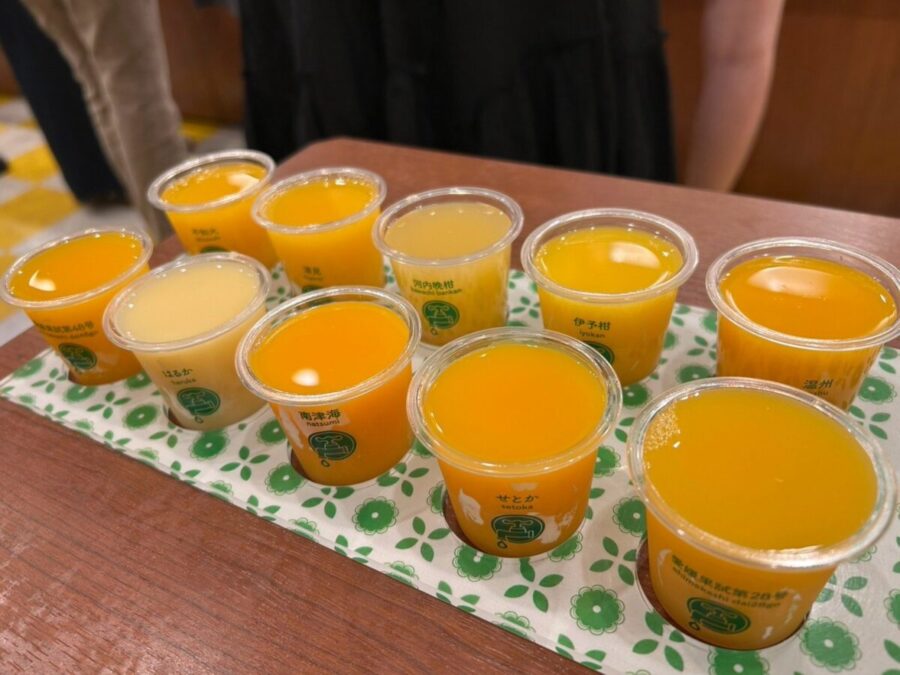
Note: Available Varieties Change by Season
Because the juices are pressed from seasonal harvests, the lineup of 20 taps rotates throughout the year. Each faucet has a helpful flavor chart indicating its sweetness, acidity, and richness, plus its per-cup price tier.
Seeing 10 cups lined up on the table was a sight to behold, and what amazed us most was how unmistakably distinct every single cultivar tasted—from pale yellow, grapefruit-like refreshers to deep crimson-orange nectars. Here are our honest tasting notes for all 10 varieties:
Flavor Breakdown of All 10 Ehime Citrus Varieties We Tried
- Haruka (はるか):
- Bright yellow in color with a brisk, zesty acidity closer to a refreshing grapefruit than a traditional sweet mandarin. Perfect as a crisp palate cleanser after a hot bath!
- Unshu / Satsuma Mandarin (温州):
- The classic, nostalgic standard of Japanese mikan juice. Smooth, comforting, and familiar—this is the quintessential flavor of Ehime.
- Setoka (せとか):
- Often praised as the “Queen of Citrus,” Setoka delivers a clean mouthfeel paired with rich sweetness and a bright fruity tang.
- Natsumi (南津海):
- My wife’s #1 favorite of the entire flight! Intensely sweet with a deep, honeyed richness. We loved it so much we bought bottled Natsumi juice as a souvenir on our way out.
- Kiyomi (清見):
- Exceptionally crisp and juicy, striking a textbook balance between lively aroma, gentle sweetness, and refreshing acidity.
- Kawachi Bankan (河内晩柑):
- Known as “Japanese summer grapefruit,” its pale golden color matches its light, bittersweet, and ultra-clean finish.
- Iyokan (伊予柑):
- Named after the historic Iyo province (modern-day Ehime), Iyokan offers a bold citrus aroma and pronounced tanginess that feels classic and invigorating.
- Shiranui / Dekopon (不知火):
- Famous across Japan as Dekopon, this variety has a full-bodied, crowd-pleasing orange flavor that everyone at the table loved.
- Beni Madonna / Ehime Kashi No. 28 (紅まどんな):
- My personal #1 pick out of all 10 varieties! Known for its jelly-like flesh as a whole fruit, Beni Madonna sits in the highest price tier at the taps, and one sip explains why—velvety, fragrant, and luxuriously concentrated.
- Beni Princess / Ehime Kashi No. 48 (紅プリンセス):
- A cross between elite cultivars Beni Madonna and Kanpei, hailed as the “thoroughbred of the citrus world.” Also in the top premium tier, its nectar-like density and sugar content are truly next-level.
Overall Impressions from Our Tasting Flight
Comparing 10 varieties side by side taught us that while the high-sugar luxury cultivars (like Beni Madonna, Beni Princess, and Natsumi) steal the show with their dessert-like richness, alternating them with crisp, tangy varieties (like Kawachi Bankan or Kiyomi) makes the sweetness pop even more. Even sampling just 3 cups is an eye-opening culinary experience!
Frequently Asked Questions (FAQ)
- QDo I need a reservation for the mikan juice faucets at Ehime no Shokutaku 1970?
- A
No reservation is needed! Simply walk in, pick up a cup (or multi-cup carrier tray) at the entrance, pour your chosen varieties from the faucets, and pay at the register according to the color-coded price tags of the taps you poured.
- QHow do I choose which mikan varieties to pour if I can’t read Japanese?
- A
Above every faucet is a visual radar chart showing three ratings: Sweetness (甘み), Acidity (酸味), and Richness/Body (コク). If you love rich and sweet juice, look for Beni Madonna (紅まどんな), Natsumi (南津海), or Setoka (せとか). For a light, grapefruit-like refresher, try Kawachi Bankan (河内晩柑). Comparing 3 varieties is the most popular option!
- QWhat is the best way to get around Dogo Onsen and wider Ehime Prefecture?
- A
Dogo Onsen Honkan and the Haikara Dori shopping street are completely walkable and connected to central Matsuyama by vintage Iyotetsu streetcars. However, if you also plan to visit Okudogo Onsen, Shimonada Station, or the Shimanami Kaido islands, renting a car from Matsuyama Airport or Matsuyama Station is by far the most convenient way to travel.
Summary: Don’t Leave Dogo Onsen Without Turning the Mikan Tap!
Ehime no Shokutaku 1970 turns a childhood dream—pouring fresh orange juice straight from a faucet—into a genuinely delicious tasting experience right in the heart of Dogo Onsen.
- Fun Retro 1970s Atmosphere: Great photos and interactive fun for couples, families, and solo travelers alike.
- Authentic Single-Origin Citrus: Backed by 10 FACTORY’s quality standards, letting you taste rare varieties like Beni Madonna and Beni Princess.
- Unbeatable Post-Onsen Refresher: Open until 9:00 PM daily, making it the ultimate cooldown drink after soaking in Dogo Onsen.

コメント