
Disclosure: This article contains affiliate links. If you book through them, we may earn a small commission at no extra cost to you.
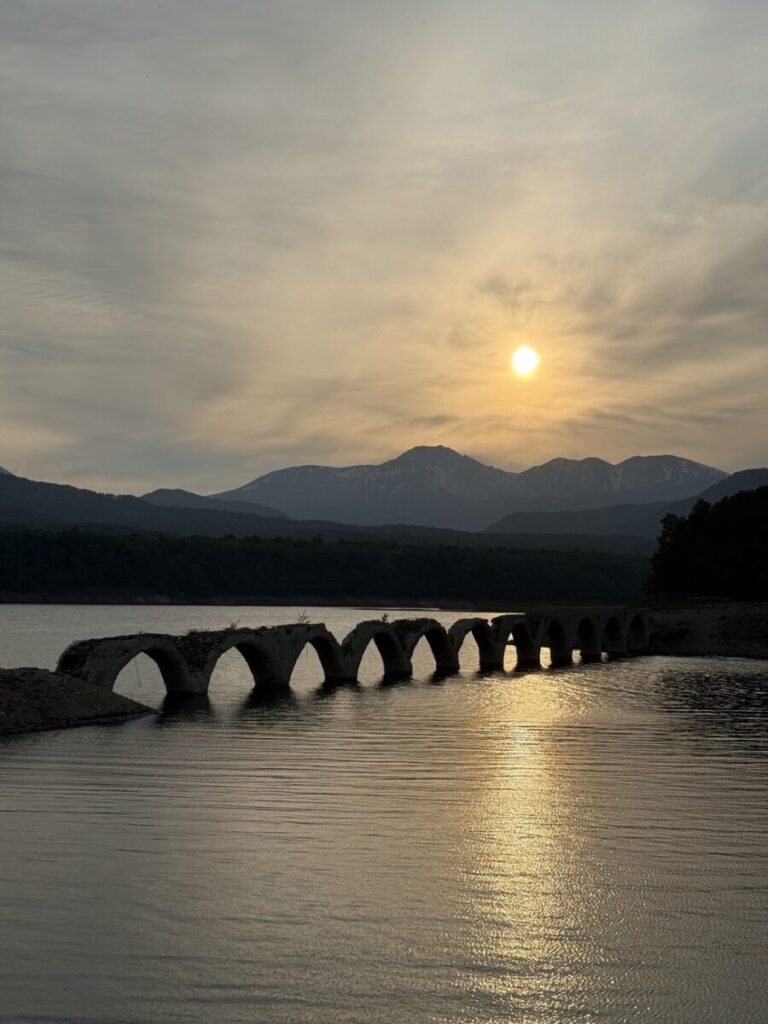
Looking back on our entire Hokkaido road trip, the single most unforgettable highlight was without question the Taushubetsu River Bridge (タウシュベツ川橋梁) in Kamishihoro, located in the northern Tokachi region.
Crumbling further with each passing year, this historic concrete arch bridge is often described as a structure that “could collapse completely at any moment” and “a sight you might never see again if you don’t go now.” True to its nickname—the “Phantom Bridge”—stepping onto the lakeshore felt like entering a lost world left behind by time, surrounded by untouched primeval wilderness.
According to our local guide, visitor numbers have been gradually increasing, yet compared to Hokkaido’s famous tourist hotspots like Sapporo, Otaru, or Furano, it remains a remarkably peaceful hidden gem where you can take in breathtaking scenery in quiet awe.
In this comprehensive guide, we share our firsthand experience joining a guided tour to see the Taushubetsu River Bridge up close, the fascinating history of why the bridge vanishes beneath the lake each year, how to book either an individual forest road gate key or a guided tour, and our surprising encounter with huge herds of wild Ezo sika deer along the way.
*Note: Our visit to the Taushubetsu River Bridge was part of a 5-day, 4-night Hokkaido itinerary covering Hakodate, Lake Shikotsu, and Tokachi. You can explore the full route and schedule in our main itinerary post below:
- Why It’s Called the “Phantom Bridge”: Built in 1937 for the former JNR Shihoro Line, the 130-meter concrete arch bridge submerges and reappears seasonally as Lake Nukabira’s water level fluctuates.
- Why You Should Visit Soon: Severe freeze-thaw cycles at -20°C and annual submergence are accelerating its natural decay—making every year’s view unique and potentially its last.
- Two Ways to Get Up Close: The forest road is locked to general traffic; you must either reserve a limited daily gate key or join a local guided nature tour.
- Why We Strongly Recommend a Guided Tour: The 4 km unpaved dirt forest road is narrow and hazardous for rental cars.
- Wild Ezo Deer Encounters: Expect to see dozens of wild Hokkaido deer in their natural habitat along the lakeshore.
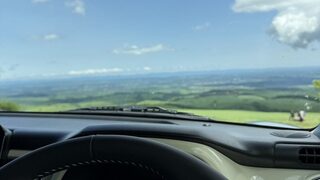
Driving Times from Major Hokkaido Cities & Airports (By Car)
- From JR Obihiro Station / Tokachi-Obihiro Airport (OBO): Approx. 1 hour 20 minutes – 1 hour 40 minutes
- From Central Asahikawa: Approx. 2 hours
- From Central Sapporo: Approx. 3 hours 40 minutes (via Doto Expressway)
- 1. What Is the Taushubetsu River Bridge? Its History & Why It’s Called the “Phantom Bridge”
- 2. How to Visit the Taushubetsu River Bridge & Reservation Methods
- 3. Our Experience: Walking Through Untouched Wilderness & Meeting Herds of Wild Ezo Deer
- 4. Frequently Asked Questions (FAQ) for International Visitors
1. What Is the Taushubetsu River Bridge? Its History & Why It’s Called the “Phantom Bridge”
Standing solitary amidst vast wilderness, the Taushubetsu River Bridge is far more than an picturesque ruin—it is an important industrial heritage structure that supported the pioneering development of modern Hokkaido. Here is the story behind the bridge and why it earned the title of “Phantom Bridge.”
A Historic 1937 Railway Bridge of the Former JNR Shihoro Line
Completed in 1937 (Showa 12), the Taushubetsu River Bridge was built as a railway bridge for the former Japanese National Railways (JNR) Shihoro Line, which once connected Obihiro Station to Tokachi-Mitsumata Station deep in the mountains. Back then, railway tracks ran across the top of the bridge, carrying steam trains loaded with timber felled from the surrounding forests and essential supplies for mountain settlements.
However, everything changed in 1955 (Showa 30) with the construction of the Nukabira Dam for hydroelectric power generation. Because the valley was flooded to create an artificial reservoir, the Shihoro Line was rerouted onto higher ground along the mountainside. While the steel rails were removed from the bridge, the 130-meter-long, 11-arch concrete viaduct itself was left standing right inside the newly formed reservoir.
Appearing and Vanishing with Lake Nukabira’s Water Levels
Today, the bridge sits inside Lake Nukabira (糠平湖), the dam reservoir inside Daisetsuzan National Park. The primary reason Taushubetsu River Bridge is called a “Phantom Bridge” is that it can only be seen during certain times of the year as the lake’s water level rises and falls dramatically for hydroelectric power generation.
While exact timing shifts each year depending on rainfall and snowmelt volume, the typical annual cycle looks like this:
- Around January (Mid-Winter): As water is drawn down for winter electricity demand, the bridge gradually begins to emerge, breaking through the thick sheet of ice covering the frozen lake.
- Spring to Early Summer (May – June): Water levels reach their lowest point, revealing the entire 11-arch bridge in full view. When gentle snowmelt water pools beneath the arches on calm mornings, the reflection forms a perfect pair of eyeglasses—earning it the nickname “Megane-bashi” (Spectacles Bridge).
- From Around August (Late Summer): Seasonal rains and typhoons cause Lake Nukabira’s water level to rise steadily, slowly submerging the lower arches of the bridge.
- October to December (Autumn – Early Winter): Typically, the entire bridge sinks completely beneath the surface of the lake, vanishing from sight until winter returns.
Because it appears and disappears over the course of a single year, the bridge presents a completely different face depending on the month you visit—from snow-blanketed ice fields to lush green early summer forests.
Made Famous by a JR Poster—Now Facing Imminent Collapse
For decades, the bridge remained a secret known mostly to local photographers and railway enthusiasts. That changed in 2008, when JR featured the Taushubetsu River Bridge on a nationwide promotional poster for its “Full Moon Couples Green Pass.” Its haunting, ethereal beauty captured the imagination of travelers across Japan, and it has appeared on numerous Hokkaido tourism posters ever since.
Today, however, the bridge faces an existential race against time. Now more than 85 years old, the unreinforced concrete structure endures an unforgiving annual cycle: freezing solid in mid-winter temperatures approaching -20°C (-4°F), thawing in spring, and submerging underwater from summer through autumn. This relentless freeze-thaw weathering is rapidly eroding the concrete.
Large sections of the outer walls and central piers have already crumbled away. Local experts note that the central arches could collapse completely at any time, and there is no guarantee that the bridge you see this year will still be standing intact next year. It is truly a once-in-a-lifetime landscape that must be witnessed while it still stands.
2. How to Visit the Taushubetsu River Bridge & Reservation Methods
Planning a visit to the Taushubetsu River Bridge requires important advance preparation. While there is a free roadside viewpoint called the Taushubetsu River Bridge Observation Deck (タウシュベツ川橋梁展望広場) along National Route 273 that anyone can stop at without a reservation, the viewpoint sits roughly 750 meters away across the lake—meaning the bridge looks quite small in the distance.
If you travel all the way to Kamishihoro, you will undoubtedly want to walk right up to the lakeshore to experience the bridge’s raw scale up close. However, the forest road leading to the lakeshore (following the abandoned Shihoro railway grade) is closed to general traffic by a locked gate to prevent accidents and protect the national park environment.
Therefore, there are only two ways to get up close to the bridge:
- Option 1: Visit Independently by Reserving a Forest Road Gate Key in Advance
- Option 2: Join an Official Local Guided Nature Tour
Option 1: Visiting Independently (Forest Road Gate Key Reservation System)
If you wish to drive your own vehicle or rental car through the locked gate to the parking area near the bridge, you must reserve a physical gate key in advance:
- Where to Book: Online via the official Kamishihoro Town Tourist Association Forest Road Gate Key reservation website.
- Booking Window: Opens at 10:00 AM exactly 30 days prior to your visit date (first-come, first-served; strictly limited number of vehicles per time slot).
- Fee: A road maintenance and conservation cooperation fee applies per reservation.
- How It Works on the Day: Pick up the physical key in person at Michi-no-Eki Kamishihoro (Roadside Station Kamishihoro) in town by presenting your driver’s license, unlock the forest road gate yourself, drive in, and return the key to the roadside station within your designated time window.
Option 2: Joining a Local Guided Tour
The second method is to join a guided tour led by licensed local nature guides who drive you through the restricted gate in their own tour vans.
- Where to Book: Directly through the Higashi Taisetsu Nature Guide Center (ひがし大雪自然ガイドセンター) website or via travel activity platforms offering Taushubetsu tours.
- Booking Window: Depending on the tour, reservations typically open around 3 months in advance, making it much easier to secure a spot early while planning your Hokkaido itinerary.
- How It Works on the Day: Meet at the guide center in Nukabira Gensenkyo Onsen village, board the guide’s 4WD vehicle, pass through the locked forest gate, and walk the final forest trail to the bridge together with expert commentary.

Why We Strongly Recommend Booking a Guided Tour Over Driving Yourself!
Having experienced the route firsthand, we wholeheartedly recommend joining a guided tour rather than driving your own rental car—and that is exactly what we chose.
Why? Because the forest road beyond the locked gate is far rougher than most travelers imagine. For roughly 4 kilometers, you must navigate an unpaved gravel dirt track that is extremely narrow, lined with blind curves, potholes, and soft shoulders. In fact, on the very day we visited, a private car had slipped its wheels into a ditch and had to wait for a JAF roadside rescue tow truck!
Note for international visitors: Many Japanese car rental insurance policies exclude coverage for tire punctures or undercarriage damage on unpaved forest roads (rindo). With a guided tour, you can simply relax in the seasoned guide’s vehicle while listening to fascinating stories about the Shihoro railway’s history and local wildlife. For both peace of mind and overall satisfaction, choosing the tour was 100% the right call.
3. Our Experience: Walking Through Untouched Wilderness & Meeting Herds of Wild Ezo Deer
Here is what it was actually like joining the guided tour and standing face-to-face with the Taushubetsu River Bridge. While photos of the bridge are striking, the atmosphere on-site surpassed anything a camera alone can capture.
A World Left Behind by Time: Walking Through Primeval Forest
After our guide navigated the narrow gravel forest road and parked at the trailhead, we set off on foot along a quiet woodland path leading out to the shore of Lake Nukabira.
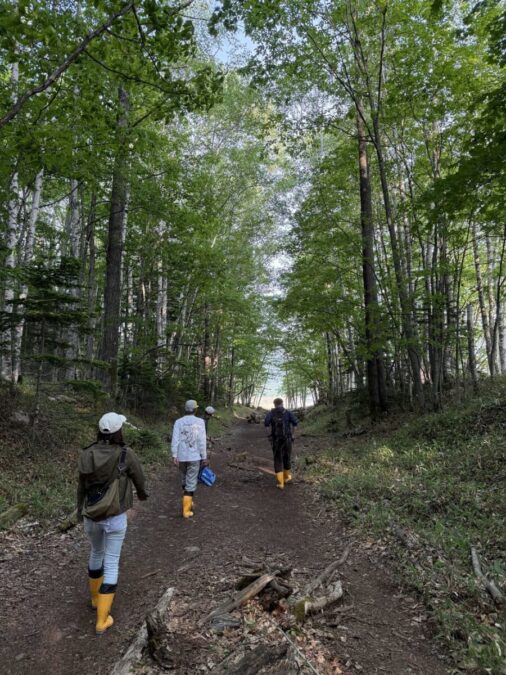
Even during this short walk through the woods, the atmosphere shifts completely. There are no tourist shops, no vending machines, and no paved walkways—only the sound of the wind through the silver birches, birdsong, and the crunch of soil and grass beneath our boots. It is the very definition of untouched nature.
The moment we emerged from the trees and the vast expanse of Lake Nukabira and the surrounding Daisetsuzan mountains opened up before our eyes, it genuinely took our breath away. The scale of the wilderness makes you feel as though you have stepped into a landscape completely forgotten by modern civilization.
Up-Close Power: Witnessing the Crumbling Concrete Arches
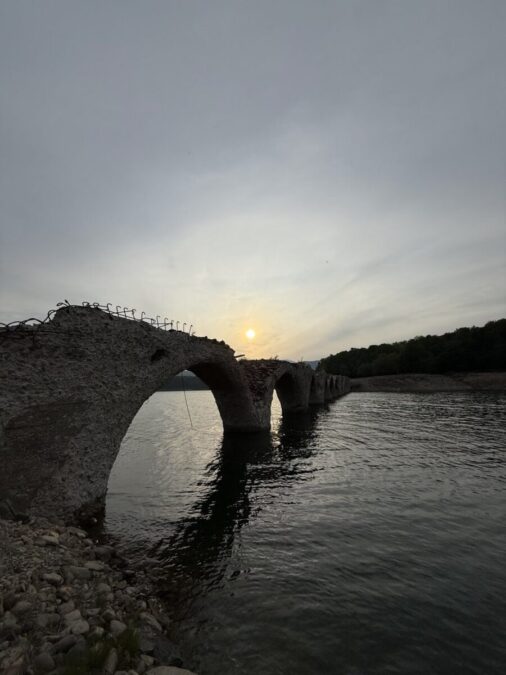
And then, right in front of us stood the Taushubetsu River Bridge.
Seen up close, massive slabs of outer concrete have peeled away, exposing the raw river stones and rusted steel rebar inside the piers. It looks so fragile that you half-expect to hear boulders tumbling down at any second. Yet strangely, there is nothing bleak or sad about it—instead, watching this monumental structure quietly return to nature carries a profound dignity and solemn beauty.
Imagining heavy steam locomotives chugging across these very arches over eighty years ago brings the weight of Hokkaido’s pioneering history to life. Precisely because the bridge is crumbling a little more every year, we felt deeply grateful to witness how it looks in this exact moment in time.
Surrounded by Wild Ezo Deer: Tourist Delight vs. Local Reality
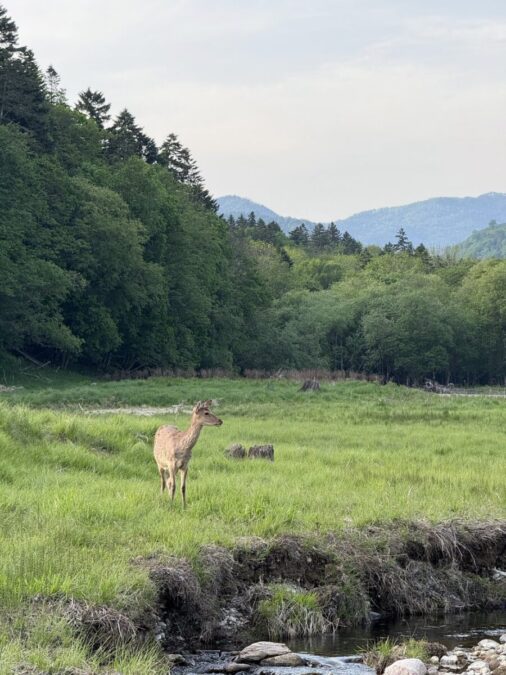
Something else left just as strong an impression on us as the bridge itself: the entire area was teeming with wild Ezo sika deer (エゾシカ).
We didn’t just spot one or two deer in the distance—along the forest road and across the open grassy flats by the lakeshore, we encountered herd after herd of wild deer grazing peacefully. It is a sight you would never experience in everyday urban life, and my wife was thrilled, exclaiming, “Look how many there are!” For wildlife lovers and photographers hoping to see iconic Hokkaido animals in the wild, this encounter alone makes the trip worthwhile.
From a visitor’s perspective, seeing so many wild deer is pure excitement. However, for local Hokkaido residents and farmers, the surging Ezo deer population has become a serious social and ecological challenge—causing extensive crop damage, stripping bark from native forest trees, and triggering frequent road collisions with cars. When driving in Tokachi, especially around dawn and dusk, always stay alert for deer crossing the highway!
4. Frequently Asked Questions (FAQ) for International Visitors
- QWhen is the best month to see the Taushubetsu River Bridge?
- A
May and June are generally the best months to see the entire 11-arch bridge standing above water surrounded by fresh green scenery, often with a mirror-like reflection on calm mornings. Late January to February is also popular for walking across the frozen lake on snowshoes to see the bridge emerging from the ice. Between October and December, the bridge is usually completely submerged.
- QWhat footwear and clothing should I bring for the tour?
- A
Wear comfortable sneakers or hiking shoes that you don’t mind getting muddy, along with long pants and a windbreaker or layered jacket (mornings at Lake Nukabira are chilly even in early summer). If the lakeshore is muddy after rain, the Higashi Taisetsu Nature Guide Center provides free rubber boots for tour participants.
- QWhere should I stay when visiting Taushubetsu River Bridge?
- A
If you book an early morning tour, staying right in nearby Nukabira Gensenkyo Onsen is very convenient. Alternatively, staying in Tokachigawa Onsen (such as the luxury ryokan Seijakubo) or downtown Obihiro is an easy 70-to-90-minute drive south and lets you combine the bridge with Tokachi’s world-class food and Moor hot springs.
Check out our detailed review of Tokachigawa Moor Onsen “Seijakubo,” where we stayed after visiting the Taushubetsu River Bridge:
コメント