
Disclosure: This article contains affiliate links. If you book through them, we may earn a small commission at no extra cost to you.
“We want to cycle the entire Shimanami Kaido in a single day—is that actually doable for complete beginners?”
If you are asking yourself that question as you plan your trip to Japan, rest assured: yes, it is! As a married couple who normally only ride bicycles to our local grocery store, we successfully cycled the entire 72 km (approx. 45 miles) route from Onomichi (Hiroshima) to Imabari (Ehime) in one day.
In this comprehensive guide, we share our honest, real-world experience as first-timers—including our exact hour-by-hour timetable, how to reserve rental bikes (and why E-bikes are a game changer), how to send your luggage ahead so you can ride hands-free, and the toughest hills to watch out for.
- Beginner-Friendly World-Class Route: How the painted “Blue Line” guides you across 6 islands and 7 bridges without needing a map.
- Travel Hands-Free: How to use same-day hotel luggage delivery and why booking an E-Bike (electric-assist bicycle) early is essential.
- Real 1-Day Timetable (9:00 AM – 5:00 PM): Our actual schedule from Onomichi Port to Imabari, including gelato stops and seaside lunch breaks.
- Honest Challenges: Navigating the midday mental wall, bridge approach slopes, saddle soreness remedies, and ferry “escape routes.”
- What Is the Shimanami Kaido?
- How Do Bike Rentals & Luggage Work? Can You Come Empty-Handed?
- Real 1-Day Timetable & Honest Impressions (Onomichi to Imabari)
- Essential Tips & Q&A for First-Time Shimanami Riders
- Frequently Asked Questions (FAQ)
- Summary: No Athletic Training Needed—Enjoy the Ride at Your Own Pace!
- More Ehime & Dogo Onsen Travel Guides
What Is the Shimanami Kaido?
The Shimanami Kaido (Nishiseto Expressway) is an approximately 70–72 km cycling and motorway corridor connecting Onomichi City in Hiroshima Prefecture (on Japan’s main island of Honshu) with Imabari City in Ehime Prefecture (on Shikoku Island). Linking six scenic islands across the Seto Inland Sea via seven architectural suspension and cable-stayed bridges, it is the only expressway in Japan where you can cross the ocean by bicycle or on foot.
History & Background Worth Knowing
Originally completed in 1999, the Shimanami Kaido was built as a vital transportation and logistics link for island residents. What made this project extraordinary was the decision to build dedicated bicycle and pedestrian lanes on every single bridge from day one.
Over the years, local communities across Hiroshima and Ehime united to transform what was once mere infrastructure into a world-renowned cycling paradise, complete with rest stations, repair stands, and cyclist-friendly cafes.
Why Is It Called the “Mecca for Cyclists”?
Cyclists from all over the world flock to the Shimanami Kaido not only for the breathtaking island scenery, but also because the route is uniquely designed so even first-time visitors can ride with total peace of mind:
- No Getting Lost with the “Blue Line”: A continuous blue guide line is painted directly onto the left side of the road along the entire route, showing you exactly where to turn and how many kilometers remain to your destination.
- Comprehensive Cyclist Support (“Cycle Oases”): Local shops, convenience stores, and roadside stations along the route serve as designated “Cycle Oases” where riders can use restrooms, refill water bottles, and borrow air pumps or basic tools for free.
- Global Acclaim: Featured by CNN as one of the world’s most incredible bike routes and designated by the Japanese government as a “National Cycle Route.”
Main Cycling Routes on the Shimanami Kaido
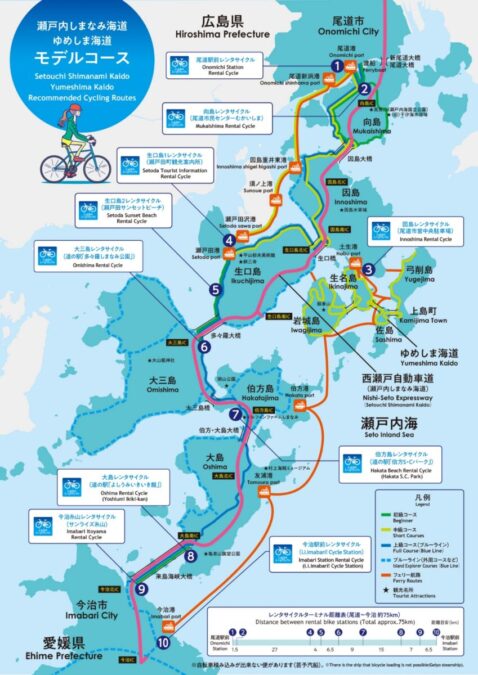
The Shimanami Kaido offers several route options tailored to your fitness level, time budget, and sightseeing goals:
- The Classic Full Crossing Route (Blue Line / Approx. 70–72 km): The standard shortest route connecting Onomichi to Imabari across six islands: Mukaishima, Innoshima, Ikuchijima, Omishima, Hakatajima, and Oshima. Because you simply follow the painted blue line on the road, you never have to worry about getting lost. (This is the route we completed in one day!)
- Recommended Sightseeing “Half Courses” (Approx. 30–40 km): Ideal for travelers who aren’t confident about riding 70 km in a single day or want more time for museums and cafes.
- Onomichi to Ikuchijima (Setoda) Course: Start from Onomichi, cycle to the lemon-growing island of Ikuchijima (home to Kosanji Temple and Sunset Beach), and take a direct passenger ferry back to Onomichi Port with your bike.
- Imabari to Omishima Course: Start from the Imabari side, cross the dramatic triple-span Kurushima Kaikyo Bridge, and explore Omishima Island.
- Relaxed Island Hopping: “Yumeshima Kaido Route” (Approx. 20 km): A peaceful detour exploring the four smaller islands of Kamijima Town (Iwagijima, Ikinajima, Sashima, and Yugejima) via short ferry hops. With virtually zero traffic lights, minimal cars, and flat coastal roads, it is wonderfully relaxing for casual riders.
- Outer Island Perimeter Routes (Advanced): Leaving the main Blue Line to circle the outer coastlines of the islands adds significant mileage and steep elevation gains, making it a favorite challenge for experienced road cyclists.
Two Unforgettable Highlights of Cycling the Shimanami Kaido
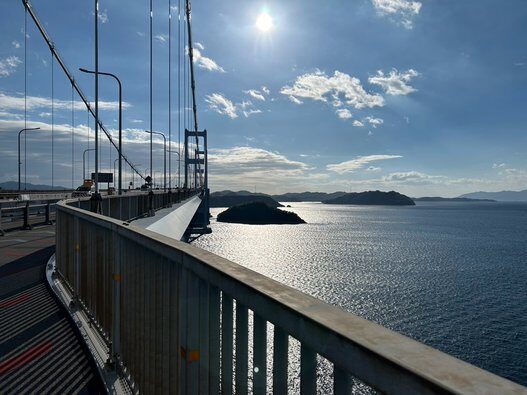
1. The Exhilaration of Cycling High Above the Sea
Looking down at the calm, island-dotted waters of the Seto Inland Sea from a bridge deck 50+ meters above the ocean while the sea breeze rushes past you is an extraordinary sensation you simply cannot experience in daily life or from inside a car.
2. The Pure Sense of Accomplishment After Riding 72 km
Pedaling under your own power all day and crossing the final massive suspension bridge into Imabari brings an overwhelming wave of pride. Knowing that “even though we only ever ride bikes to the supermarket, we just conquered 72 km across the sea!” is a memory that stays with you forever.
How Do Bike Rentals & Luggage Work? Can You Come Empty-Handed?
Many international visitors worry: “We don’t have cycling gear with us in Japan—is that okay?” or “What do we do with our suitcases and backpacks while riding 70 km across to another city?”
The short answer is: You can show up almost completely empty-handed.
The two keys to a smooth, stress-free crossing are 1) Booking the right rental bike in advance and 2) Using a same-day luggage forwarding service.
1. Choosing & Booking Your Rental Bicycle
Both Onomichi and Imabari—as well as the islands in between—have numerous public rental terminals and private specialty bike shops. Even if you have never ridden a sport bike before, staff will adjust the saddle height and explain the gears before you set off.
- Types of Bicycles Available:
- E-Bike (Electric-Assist Bicycle): Our #1 recommendation for beginners. The electric motor assists your pedaling on steep bridge climbs.
- Cross Bikes (Hybrid Bikes) & Road Bikes: Lightweight multi-gear sport bikes suited for active riders looking for a brisk workout.
- City Cycles (Mamachari): Heavy upright commuter bikes suited only for short 5–10 km island strolls (not recommended for a 70 km full crossing).
- Where to Rent:
- Public Rental Terminals (Shimanami Japan / Red Bicycles): Operates 10 terminals across the route with flexible one-way drop-off at any terminal (note: one-way drop-off for E-bikes is limited to specific terminals/plans).
- Private Specialty Shops (ONOMICHI BASE, GIANT Store Onomichi/Imabari, etc.): Offer well-maintained, newer-model E-bikes, mini-velo E-bikes, and high-performance road bikes.
Book Early During Peak Seasons & Weekends!
We visited during a holiday weekend in autumn, and every rental shop was packed with cyclists. If you show up without a reservation during spring (cherry blossom season), autumn (October–November), or weekends, E-bikes and popular sizes often sell out completely.
For our ride, we rented from Rent-a-Cycle ONOMICHI BASE (onomichi-base.com), located just a 5-minute walk from JR Onomichi Station. Check-in was super smooth, the bikes were in pristine condition, and the staff gave us a thorough briefing before departure.
Why We Strongly Recommend an E-Bike for Beginners
While the coastal roads around each island are mostly flat, every time you cross one of the seven bridges, you must climb an dedicated approach ramp to reach the bridge deck high above the shipping lanes.
Each bridge climb is a continuous 1 to 2 km uphill slope (typically a gentle 3% incline, though some island passes reach 5–7%). Doing that once is easy—but repeating it seven times over 70 km gradually drains beginner legs. Having an E-bike flattens out those climbs so you can save your energy and keep smiling all the way to Imabari.
2. What About Suitcases? Use Same-Day Luggage Delivery
Riding 72 km with a heavy backpack will quickly cause shoulder pain and saddle discomfort. Instead, take advantage of same-day baggage delivery services operating between Onomichi and Imabari.
Simply drop off your luggage in the morning at the starting point (or your Onomichi hotel front desk), and it will be waiting for you at your destination hotel in Imabari (or vice versa) by late afternoon:
- Sagawa Express “Hands-Free Cycling” (Official Site): Same-day luggage transfer between partner hotels and terminals in Onomichi, the islands, and Imabari.
- Shimanami Teburabin (Official Site): Convenient same-day baggage delivery directly affiliated with ONOMICHI BASE and partner hotels.
We used this same-day delivery service ourselves, allowing us to cycle with nothing more than a tiny daypack for valuables and water. It made a huge difference in conserving our stamina.
Summary: Only 2 Things to Prepare in Advance
- Reserve a properly fitted rental bicycle (especially an E-Bike if you are a beginner) well ahead of your trip.
- Arrange same-day luggage forwarding so you don’t carry heavy bags on the bike.
Once those two items are checked off, all you need are comfortable athletic clothes and sneakers!
Real 1-Day Timetable & Honest Impressions (Onomichi to Imabari)
Cycling the full 72 km from Onomichi to Imabari at a relaxed sightseeing pace—including photo stops, gelato breaks, and a proper sit-down lunch—takes roughly 8 hours from morning to late afternoon.
Here is the exact schedule we followed as a beginner couple, along with what we loved and where we struggled.
Our Actual Hour-by-Hour Cycling Schedule
Onomichi → Imabari (72 km) 1-Day Real Timeline
- 08:15 AM: Arrive at Rent-a-Cycle ONOMICHI BASE (Check-in, saddle adjustment, gear briefing & luggage drop-off)
- 08:50 AM: Board the short local ferry from Onomichi Port across the channel (skipping the first bridge as recommended for cyclists)
- 09:00 AM: Disembark on Mukaishima Island & officially start pedaling!
- 11:00 AM: Sweet treat break on Ikuchijima Island (Famous citrus gelato at Shimanami Dolce)
- 12:15 PM – 01:15 PM: Lunch break at Michi-no-Eki Tatara Shimanami Park on Omishima Island (Took a full 1-hour rest)
- 01:45 PM: Quick dessert stop at Michi-no-Eki Hakata S.C. Park (Famous Hakata Salt Soft-Serve Ice Cream)
- 03:30 PM: Final afternoon break at Michi-no-Eki Yoshiumi Rose Park on Oshima Island
- 04:30 PM: Cross the grand finale—the 4 km Kurushima Kaikyo Bridge during golden hour
- 05:00 PM: Arrive at the Imabari Return Terminal — Goal Achieved!
What We Loved & How Our Bodies Felt Afterward
- Breathtaking Bridge Panoramas: Every island and bridge has its own personality. In particular, crossing the final Kurushima Kaikyo Bridge around 4:30 PM as the afternoon sun glinted off the whirlpools below was awe-inspiring in scale.
- Frequent Gourmet Rest Stops: Because roadside stations (Michi-no-Eki) and cafes are spaced cleanly across every island, you can break the 72 km ride into bite-sized 10–15 km segments rewarded by Setoda lemon gelato, seafood bowls, and salted soft-serve ice cream.
- Surprisingly Little Muscle Soreness the Next Day! Hearing “72 km” made us brace ourselves for total exhaustion the following morning. To our surprise, both my wife and I had plenty of energy left at the finish line, and we barely had any leg soreness the next day. By pacing ourselves and taking a full hour for lunch, even non-athletes can comfortably complete this ride.
The Hardest Parts: Honest Struggles Along the Way
- The Midday Mental Wall Before Lunch: Our toughest moment came between leaving the gelato shop on Ikuchijima, crossing the Tatara Bridge, and reaching our lunch stop on Omishima around noon. Fatigue was starting to set in, and realizing “We’ve been pedaling for three hours and we still aren’t even halfway?!” hit us hard mentally. At that point, my wife half-seriously sighed, “Maybe we should catch a ferry…” Thankfully, sitting down for a hot lunch and resting for a full 60 minutes completely recharged our spirits.
- Relentless Uphill Slopes on the Final Island (Oshima): Unlike the flat coastal paths of the first few islands, the Blue Line route across Oshima (the final island before Imabari) cuts inland through hilly terrain, followed by the long climb up to the Kurushima Kaikyo Bridge. Tackling repeated uphill stretches late in the afternoon when your legs are already tired is tough—and this is where you will be eternally grateful if you rented an E-Bike!
Essential Tips & Q&A for First-Time Shimanami Riders
Q1. Will my backside hurt from the bike saddle?
A. Honestly, yes—expect some saddle soreness in the second half.
Because sport bike saddles are firmer and narrower than city bikes, sitting on one for 6–8 hours will inevitably cause soreness if you aren’t used to it. We rode without padded shorts, and while it never became painful enough to stop us from finishing, we definitely felt it during the last 20 km.
- Easy Budget Fix: Pick up a gel or cushion saddle cover at a Japanese 100-yen shop (like Daiso) before your trip, or rent a cushioned cover if your bike shop offers one.
- Best Fix: Wear padded cycling inner shorts under your regular shorts or leggings.
Q2. What if we get too tired or run out of time halfway through?
A. You can bail out anytime using island ferries or cycle buses!
One of the best things about the Shimanami Kaido is that it has built-in “escape routes.” Ferry ports on the islands allow you to roll your bicycle directly onto a boat back to Onomichi or onward toward Imabari, and highway buses/taxis equipped for bikes also operate along the corridor. Just knowing “if worse comes to worst, we can hop on a ferry” takes away all the pressure.
Q3. What should we wear and bring?
A. Breathable athletic layers, sunglasses, and sunscreen for the backs of your hands!
You do not need tight Lycra cycling jerseys. I wore a quick-dry Uniqlo Dry-EX T-shirt and athletic shorts over breathable sports leggings, which kept me comfortable all day. However, don’t overlook these two small essentials:
- Sunglasses (Eyewear): You pick up speed coasting down from the bridges, and the wind can dry out your eyes or blow tiny insects and dust into your face. Any pair of regular sunglasses makes riding much more comfortable.
- Sunscreen on the Backs of Your Hands (or Cycling Gloves): Even on a slightly overcast day, your hands remain gripping the handlebars in direct UV light for 7 hours straight. I remembered to put sunscreen on my face, but completely forgot the backs of my hands—and ended up with deeply tanned hands by 5:00 PM!
Q4. Do we need to carry lots of water bottles?
A. No—one bottle per person is plenty.
Vending machines, Japanese convenience stores (7-Eleven, Lawson, FamilyMart), and roadside stations are dotted along every island. You can easily buy cold drinks whenever you stop without weighing yourself down.
Frequently Asked Questions (FAQ)
- QCan a beginner couple really finish the 72 km Shimanami Kaido in 1 day?
- A
Yes! As long as you start early in the morning (ideally between 8:00 AM and 9:00 AM), pace yourself with regular rest stops, and use your gears on the bridge ramps, beginners can complete the route before 5:00 PM. If you are worried about stamina, reserving an E-bike makes the uphill climbs effortless.
- QWhat are the absolute must-have items for Shimanami Kaido cycling?
- A
Padded cycling shorts (or a gel saddle cover) to prevent saddle soreness, sunglasses to protect against wind and glare, sunscreen (especially on your hands and neck), and some cash (100-yen coins) for the short Onomichi ferry and island snack stands.
- QWhere should we stay after finishing the ride in Imabari?
- A
If you ride from Onomichi to Imabari, we highly recommend taking a 35-minute JR limited express train or highway bus from Imabari Station to Matsuyama and staying at Dogo Onsen (or Okudogo Onsen). Soaking tired muscles in one of Japan’s oldest natural hot springs after a 72 km ride is pure bliss.
Summary: No Athletic Training Needed—Enjoy the Ride at Your Own Pace!
Even with zero regular exercise habits, my wife and I completed the entire 72 km crossing from Onomichi to Imabari in a single day—and it immediately became one of the most rewarding travel days of our lives.
- The “Just Right” Challenge: Far less grueling than a marathon, yet challenging enough to give you a genuine sense of adventure.
- Unbeatable Achievement: Crossing seven bridges over the ocean under your own pedal power.
- Postcard Scenery at Every Turn: Turquoise straits, citrus groves, and tranquil fishing villages that you only truly notice at bicycle speed.
Along the trail, we passed everyone from retirees to families with young children enjoying the islands at their own rhythm. Whether you tackle the full 72 km crossing or opt for a leisurely half-day course, be sure to put the Shimanami Kaido at the top of your Japan itinerary!
More Ehime & Dogo Onsen Travel Guides
Pair your Shimanami Kaido ride with these must-visit spots in Matsuyama and Ehime Prefecture:

コメント